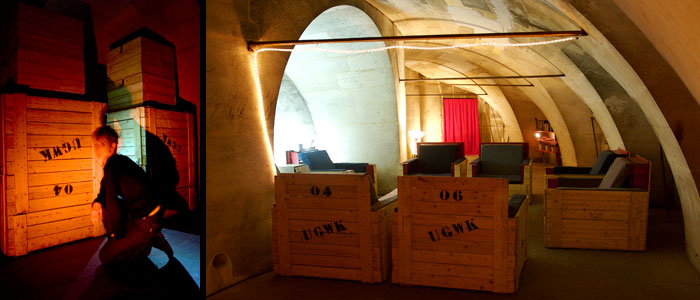
Hey, people! They were not there to fix a clock! You can see the hideout here.Four members of an underground "cultural guerrilla" movement known as the Untergunther, whose purpose is to restore France's cultural heritage, were cleared on Friday of breaking into the 18th-century monument in a plot worthy of Dan Brown or Umberto Eco.
For a year from September 2005, under the nose of the Panthéon's unsuspecting security officials, a group of intrepid "illegal restorers" set up a secret workshop and lounge in a cavity under the building's famous dome. Under the supervision of group member Jean-Baptiste Viot, a professional clockmaker, they pieced apart and repaired the antique clock that had been left to rust in the building since the 1960s. Only when their clandestine revamp of the elaborate timepiece had been completed did they reveal themselves.
Tuesday, November 27, 2007
There is no cabal.
This is obviously the first (or last?) step in a Masonic conspiracy:

Monday, November 26, 2007
50 book challenge: #49.
#49: Michael Chabon, The Yiddish Policemen's Union. The novel's originality of concept is praiseworthy, but the execution was quietly annoying, and a little half-baked. The plot moved slowly, too slowly if the idea was to mimic a Chandler novel. And there seemed to be too much overwritten description: all very artfully done, but seeming like the product of a writing workshop exercise ("O.K., now your main character, this Landsman fellow, meets a scrappy Alaskan bush pilot. Bring the bush pilot to life in 150 words.") In other words, every character introduction was accompanied by a very inventive description of clothing, quirks, facial features, etc., but how is that enhancing my enjoyment of the story, or necessary to it? Maybe my expectations were too high.
Friday, November 23, 2007
Now that's a mishpacha.


Tuesday, November 13, 2007
50 book challenge: #46, 47, #48.
#46: Selected Letters of Marcel Proust. This is the other "0.5." What a snob! No surprise he did nothing remarkable in his life, har har.
#47: Chekov, Complete Short Novels, Complete Stories, trans. Pevear & Volokhonsky. Of the short novels, I read The Steppe and The Duel, and a smattering of the stories. I would have gladly continued, but the silly library refused to let me renew more than I already had. Anyway, never having read any of this writer's stuff before, this was brilliant.
#48: George Saunders, In Persuasion Nation. Too often, these stories were "funny" but not all that funny. Also, the stories didn't really tell a story - and that wasn't their purpose, to be fair - as much as present variations on a theme, that theme being rampant consumerism is deadening our souls omigod amirite? And the thing is, sure, I agree, but I'm not ready to join the church. The Red Bow was good, with some subtle touches, and again, it was true - the madness that can follow in the collective response to a tragedy, sometimes well-intentioned but sometimes not - but its force was monotonic. Good long interview with Saunders here.
I haven't read this book yet.
From a TLS review of Pierre Bayard's Comment Parler des Livres Que L'on N'a Pas Lus (How to talk about books that you haven't read):
Bayard’s project is a serious one. He tells us, in his “Prologue”, that he was born into a family who read little, that he himself has almost no appetite for reading and that, anyway, he cannot find the time for it. As a (fifty-two-year-old) professor of French literature at the University of Paris VIII (and a practising psychoanalyst), he often finds himself obliged to comment on books he hasn’t looked at. And yet “non-reading” is a taboo subject in the circles in which he moves. He lists three constraints that we all feel as readers: “The first of these constraints could be called the obligation to read. We live in a society . . . in which reading still remains the object of a form of sacralization”, particularly where certain “canonical texts” are concerned: it is practically forbidden not to have read these. The second constraint “could be called the obligation to read a book in its entirety. If non-reading is frowned on, speed-reading and skimming are viewed in as poor a light”. For example, “it would be almost unthinkable for professors of literature to admit – what is after all true for most of them – that they have merely skimmed Proust’s work”. Can this really be the case? If so, it’s a dismaying thought – presumably Bayard has had some explaining to do to his colleagues since his book was published in France earlier this year. The third constraint, and the one which most of us would take as given, is the need to have read a book in order to be able to talk about it: according to Bayard, it is perfectly possible to have a fruitful discussion about a book one hasn’t read, even with someone who hasn’t read it either. These constraints lead to a lack of openness in our dealings with each other, Bayard claims, and generate unnecessary feelings of guilt.And here from Jay McInerney in the N.Y. Times, on the English translation. (I really only skimmed this last review, I must confess.)
He does not address the fact that most of us have our blind spots where particular authors are concerned, and that many of us do feel oppressed by the thought of the books we haven’t quite got round to reading, or wish that we had read years ago and know we now never will. Bayard is not interested in this; instead, he divides the works he mentions into four categories: “LI” indicates “livres inconnus” (books he is unfamiliar with); “LP” “livres parcourus” (books glanced at); “LE” “livres dont j’ai entendu parler” (books he has heard discussed) and “LO” “les livres que j’ai oubliés” (books he has read but forgotten). Ulysses, for example, falls into the category “LE”: he claims not to have read the novel, but he can place it within its literary context, knows that it is in a sense a reprise of the Odyssey, that it follows the ebb and flow of consciousness, and that it takes place in Dublin over the course of a single day. When teaching he makes frequent and unflinching references to Joyce.
Wednesday, November 07, 2007
Richard Mellon Scaife, you dog.
Charter member of the vast right-wing conspiracy:
Unfathomable but true, when Scaife (rhymes with safe) married his second wife, Margaret "Ritchie" Scaife, in 1991, he neglected to wall off a fortune that Forbes recently valued at $1.3 billion. This, to understate matters, is likely going to cost him, big time. As part of a temporary settlement, 60-year-old Ritchie Scaife is currently cashing an alimony check that at first glance will look like a typo: $725,000 a month. Or about $24,000 a day, seven days a week. As Richard Scaife's exasperated lawyers put it in a filing, "The temporary order produces an amount so large that just the income from it, invested at 5 percent, is greater each year than the salary of the President of the United States."The Post has the story.
Tuesday, October 30, 2007
50 book challenge: #45, #45.5
#45: Bulgakov, The Master and Margarita. There are some books that you feel obligated to pick up and read because of their status as classics, but which you have been avoiding because you fear they will be dull dull dull. Then, without even getting past the first page you realize that instead the book justifies all the sort of adjectives that are maybe more commonly used for popular literature: a page-turner, unputdownable, laugh-out-loud funny, etc.
For me, War and Peace was like that. The three worst words in the book are its title. They're just so ponderous and vague, which is utterly unlike the actual text and action of the novel, even the more philosophical portions. (Tolstoy should have stuck with his original title, 1805.) Anyway, The Master and Margarita, while not really comparable to War and Peace, was similar. There must be some superficial quality of classic Russian novels that intimidates me, but it's not like I'm reading them in the original language. . . But in fact the Russian novelists that I've read - Tolstoy, Dostoevsky, and Bulgakov if you include him on the basis of this novel - in fact have a reliably playful quality to them.
So in The Master and Margarita, the devil visits Moscow and wreaks havoc on the city's population. Interpolated are chapters on Pontius Pilate's role in the trial and crucifixion of a man named Yeshua ha-notsri, as related by Satan but also in chapters of a book written by another character known as "the master." Oh, and have I mentioned the trigger-happy black cat the size of a hog, who stands on two feet and knocks back shots of vodka? By the way, prospective readers should note that Jimmy Buffett has nothing to do with the story.
#45.5: James Kugel, How to Read the Bible. Begin at the beginning, continue to the end, then stop. This is a fascinating reference book, but I wasn't about to read it straight through. So I figure I'd treat the portions I did read as about half a book.
Sunday, October 28, 2007

Friday, October 26, 2007
Shuffling off.
The solution to Buffalo's problems? "Shrinking to greatness," according to Harvard economist Edward Glaeser.
Subscribe to:
Posts (Atom)

 Posts